The short answer
A belt squat is a heavy squat done with the load hanging from a belt around your waist instead of a barbell across your shoulders, which means you can train your legs hard without any of the spinal compression that pushes most lifters off the barbell in their forties. If your back has ever locked up after a heavy squat day, if your shoulders no longer let you sit a low bar comfortably, if your knees are the limit on your training rather than your legs, a belt squat solves all of that. The machine is the single most important piece of equipment for any lifter who wants to keep squatting heavy into their fifties, sixties, and beyond. Most lifters who buy one regret only that they did not buy it five years earlier.
Prefer video? Here is the Belt Squat Machine 2.0 walked through end-to-end:
The lift that breaks lifters in their forties
If you have been lifting for fifteen years or more, you already know what this article is about before you read another word. The barbell back squat is the king of leg exercises, and somewhere in your late thirties or early forties, the king starts asking for tribute.
It is never your legs that give out first. Your quads still want to work. Your glutes are still strong. The thing that tells you to stop is your back. Or your shoulders, when you cannot get them into low-bar position without a sharp pain. Or your knees, on the days you have stacked too many heavy squat sessions in a row. Or your hips, on the morning after a hard PR attempt.
The barbell squat puts every pound of load through your spine before it ever reaches your legs. That is fine when you are 25 and your spine does not argue. It is a different conversation when you are 45 and the cumulative stress of two decades of squatting starts to show. You can foam roll, you can mobilize, you can do all the prehab on Earth, and you will still hit a point where your legs can take more weight than the rest of you can deliver to them.
Most lifters respond by lowering the weight. Some quit barbell squatting altogether. A small number of lifters figure out the actual answer, which is: change the tool.
What is a belt squat?
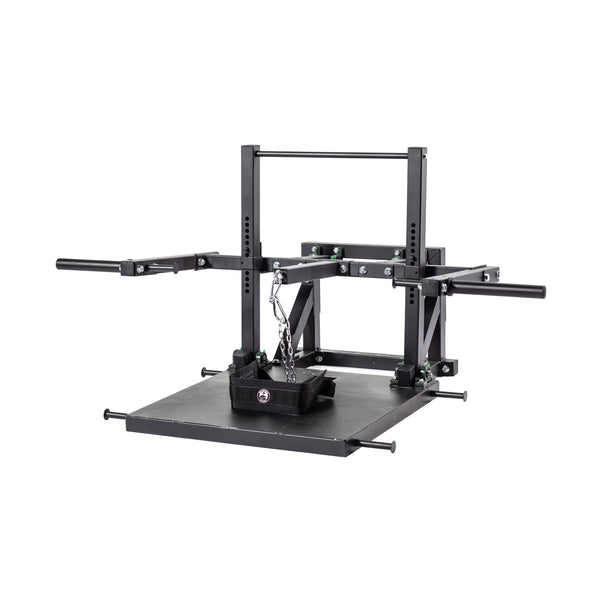
A belt squat is a squat variation where the resistance is loaded onto a belt worn around your hips instead of a barbell held across your shoulders. The lifter stands on a platform of the machine, steps into a belt that connects to a load arm with weight pegs, and squats while the load pulls down on their hips.
The mechanics of the squat itself are surprisingly close to a free squat. You stand on the platform of the machine, step into the belt, adjust the height so the lift starts from your full standing position, and squat. The belt pulls down. Your legs push back up. Range of motion is the same as a regular squat. The only thing that is missing is the part that hurts.
Belt squats originated in the powerlifting world, where they were used by lifters with chronic back issues as a way to keep training legs heavy without aggravating injuries. They have since migrated into general strength training, bodybuilding, and home gyms because of one specific quality: heavy leg loading without spinal compression. That benefit is too valuable to keep limited to lifters who are already injured. Aging lifters, athletes with old injuries, and high-volume hypertrophy trainees all benefit from adding belt squats to their programming.
What muscles does a belt squat work?
The belt squat is a compound lower-body exercise that primarily trains the quads and glutes, with significant secondary involvement from the hamstrings, adductors, and calves.
- Quadriceps: Primary mover. The squat pattern itself drives most of the quad work. A narrower stance shifts even more emphasis onto the quads.
- Glutes (gluteus maximus): Heavy primary. The hip extension at the top of every rep recruits the glutes hard, especially with a wider stance.
- Hamstrings: Significant secondary. Especially loaded on the descent and through the bottom of the rep when the hips are most flexed.
- Adductors: Secondary. The stance variations on a belt squat let you bias adductor work more than a standard back squat allows.
- Calves: Stabilizers. Active throughout the rep to keep the foot anchored on the platform.
- Core: Bracing. You still need a tight midsection to transfer force, but the demand is dramatically lower than a back squat because there is no bar to stabilize.
The most important thing the belt squat does not work is the spinal erectors. That is precisely the point. By removing the bar from your spine, you remove the structural cost of heavy squatting while keeping all the leg-training benefits.
Belt squat vs back squat: which is better?
Neither is universally better — they each do specific jobs better than the other. The right question is not "which is better?" It is "which is better for what you are trying to accomplish today?"
| Factor | Belt Squat | Back Squat |
|---|---|---|
| Spinal load | Zero compression | High compression |
| Shoulder mobility required | None | High |
| Core demand | Low to moderate | High |
| CNS fatigue per rep | Low | High |
| Recoverability | High (3–5x per week possible) | Lower (1–2x per week typical) |
| Whole-body strength carryover | Lower | Higher |
| Best for | Aging lifters, high-volume work, joint-friendly heavy loading, training around injury | Younger lifters, athletic carryover, bracing development, sport-specific training |
The simple rule for an aging lifter: if your back, shoulders, or knees still tolerate the back squat without paying for it the next day, keep it as your primary. Add belt squats as a supplemental movement to add volume your body could not otherwise recover from. If your back, shoulders, or knees no longer tolerate barbell squatting, the belt squat takes over as your primary, and you keep training heavy without the structural cost.
The 5 problems a belt squat solves for aging lifters
The four problems that drive most lifters off the barbell after 40 — back pain, shoulder mobility, knee stress, and recovery — all get solved or dramatically reduced by switching to a belt squat. Here is the breakdown.
1. Spinal compression and back pain
Spinal compression is what turns into low-back tweaks, SI joint issues, and disc problems over time. The cumulative load of two decades of heavy back squatting puts wear on the structures of the spine that does not show up immediately but eventually does.
A belt squat has zero spinal compression. The load travels from a belt at your hips, down through your legs, into the platform of the machine. Your spine never sees a single pound. You can train heavy with a back that would never tolerate a barbell on it, and you can do it as often as your legs can recover. For lifters who have already hit a wall with the barbell squat, the belt squat is the difference between training hard and not training at all.
2. Shoulder mobility
Holding a bar on your back demands external shoulder rotation, lat tension, and elbow position you do not get back once you have lost it. Lifters in their forties almost universally find that the bar position they used to find easy now feels wrong. A belt squat asks for none of that. There is no bar. There is no bar position. There is no shoulder demand. You step into the belt and squat.
This solves a problem most aging lifters do not realize they had until they remove it. Lifters who have been compensating for tight shoulders for years often discover they can squat deeper, more comfortably, and with better form on a belt squat than they have been on a barbell for the last decade.
3. Knee stress
The load path on a belt squat is closer to vertical than a back squat, which generally reduces shear at the knee. Lifters with old meniscus issues, patellar tendon problems, or just generic "my knees ache after squat day" complaints often find the belt squat is the only heavy squat variation that does not aggravate them.
The knee benefits also come from stance flexibility. With no bar position constraint, you can adjust your stance freely until you find the angle and width that lets your knees track cleanly. That kind of personalized setup is impossible with a barbell because the bar position dictates how you squat.
4. Recovery
A heavy back squat is a central nervous system event. You can do them once or twice a week and need a full day to recover from each. Belt squats produce a fraction of that systemic fatigue, which means you can squat more often without your overall training quality suffering.
Aging lifters often need more total volume than they used to but less per-session intensity. Belt squats let you split the volume across more sessions, which means you accumulate more weekly work without crushing yourself in any single workout. Three belt squat sessions a week of moderate volume often produce better leg gains than one heavy back squat session a week.
5. Frequency limits
The biggest gift the belt squat gives an aging lifter is the freedom to train legs more often. Lifters who could squat hard once a week in their thirties often find they can belt squat four times a week in their forties. The math of total weekly volume tilts dramatically in your favor when each session has a fraction of the recovery cost.
This is the underrated reason aging lifters who switch to belt squats often gain leg size in their forties they could not in their thirties. They are not training easier. They are training more often, and more often is what builds muscle.
Belt squat benefits beyond aging lifters
The aging-lifter case is the most obvious one, but the belt squat earns its place in any home gym for reasons that have nothing to do with age.
- High-volume hypertrophy. Sets of 20 belt squats build legs in a way nothing else does. Lifters who run high-volume hypertrophy blocks on the belt squat regularly report leg-size gains they could not match with barbell squatting.
- Training around injury. A bad shoulder, a tweaked back, a knee that flared up — all of these end barbell squat days. None of them end belt squat days. The machine keeps you in the gym while everything else heals.
- Conditioning work. Belt squat marches, walking belt squats, and high-rep cluster sets turn the machine into a leg conditioning tool that no barbell variation can match.
- Athlete-specific work. Sport-specific movement patterns — loaded marches, single-leg work, lateral squats — are easier and safer on a belt squat than with a bar on your back.
- Programming flexibility. Pair belt squats with heavy back squats in the same training week and you get more leg work without doubling the recovery cost.
How to use a belt squat machine: step-by-step
Setup is simpler than a barbell squat, but the cues that make a belt squat productive are easy to miss. Here is the full step-by-step.
- Set the belt height. The lift should start from your full standing position. Most belt squat machines have an adjustable height pin or carriage. Set it so when you stand up under load, you are in a neutral standing posture — not bent forward at the hips, not standing tall on your toes.
- Step into the belt. The belt sits at your hips, just below the iliac crest. Cinch it tight enough that it does not slip during the lift but not so tight it constricts. The first session feels strange. By the third session you stop noticing it.
- Find your stance. Wider stance biases the glutes and adductors. Narrower stance biases the quads. Most lifters land somewhere shoulder-width, but the beauty of the belt squat is you can experiment without a bar position fighting you.
- Brace your core. Even without a bar on your back, you want a tight midsection — it stabilizes the hips and lets you transfer force cleanly into the lift. Take a big breath, brace, then lift.
- Squat to depth. Sit down and back. Most lifters find they can hit depth more easily than on a back squat because there is no bar position fighting their hip angle.
- Drive up. Push the floor away. Stand back up to lockout. Squeeze your glutes at the top of every rep.
- Reset between reps. Take a fresh breath at the start of every rep. Do not chain reps without resetting your brace. A belt squat lets you do high-rep work without bracing fatigue limiting you, but you still need to brace correctly.
Add bands for accommodating resistance
Most quality belt squat machines include band pegs at the top of the frame so you can attach resistance bands to the load arm. The bands stretch as you stand, which adds tension at the lockout — exactly where most squatters are strongest. This is the same accommodating-resistance principle Westside Barbell built their training methodology on, and it works as well for aging lifters as it does for competitive powerlifters. Heavy load at the bottom, heavier load at the top, more total work done across the rep.
5 common belt squat mistakes
The belt squat is more forgiving than a back squat in almost every way, but lifters new to the machine still tend to make the same handful of mistakes. Avoiding these gets you to better gains faster.
1. Setting the start height too low
If your start position has you slightly bent forward or with your hips already flexed, the belt squat fights you instead of working with you. The lift should start from your fully standing position. Adjust the height pin so when you are loaded, you are in your neutral standing posture, not pre-flexed.
2. Treating it as an "easy version" of squat
The belt squat is not a back squat with the difficulty turned down. It is a different exercise that does specific jobs better. Treating it as a lighter alternative leads to under-loading and missing out on the actual benefits. Train it heavy. Most lifters end up using more weight on their belt squat than on their back squat once they get used to the movement.
3. Letting the eccentric drop fast
The descent is where most of the muscle damage happens. A controlled 2–3 second eccentric on every rep is what builds legs. Aging lifters in particular benefit from slow eccentrics because they work the muscle harder without adding more peak load to the joints.
4. Skipping the band setup
Bands are not optional. Accommodating resistance is one of the major reasons the belt squat is more productive than a back squat for most lifters past 40. Most quality machines come with band pegs — use them. Heavy band tension at lockout produces glute development you cannot get otherwise.
5. Not exploring stance variations
One of the underrated freedoms of the belt squat is that you can change stance without a bar position constraining you. Wide stance, narrow stance, single leg, B-stance, sumo — all of them work. Lifters who only use one stance miss out on most of what the machine can do.
Belt squat exercise variations
Beyond the standard belt squat, the machine handles a wide range of leg-training movements. Lifters who only use the machine for squats are leaving most of its value on the floor.
- Wide-stance belt squat: biases glutes and adductors. Best for high-rep glute work.
- Narrow-stance belt squat: biases quads. Use for quad-emphasis blocks.
- Pause belt squat: 3-second pause at the bottom. Builds raw bottom-end strength faster than any other belt squat variation.
- Tempo belt squat: 4-second eccentric on every rep. Brutal hypertrophy stimulus.
- Single-leg belt squat: step one foot off the platform. Suddenly you have a brutal split-squat alternative without needing a separate setup.
- Belt squat good morning: standing in the belt, hinge at the hips instead of squatting. Hamstring and lower back focus without spinal compression.
- Belt squat march: high-volume conditioning. Stand in the belt and march in place. Burns glutes and quads while also building work capacity.
- Belt squat reverse lunge: step one leg back at a time. Brutal unilateral glute work with no balance demand.
- Banded belt squat: add bands for accommodating resistance.
- Cluster set belt squat: 5 reps, rest 15 seconds, 5 reps, rest 15 seconds. Works for hypertrophy, strength, or conditioning.
How to program belt squats for an aging lifter
The standard advice for aging lifters is "squat less, squat lighter." That advice is wrong. The right answer is "squat differently." A belt squat changes the math on what is recoverable, which means an aging lifter can train legs more often on a belt squat than they could on a barbell squat.
Option 1: Belt squat as your primary squat (twice a week)
Replace your barbell back squat with the belt squat as your main lift. Twice a week, once heavy (sets of 5–8), once high-volume (sets of 12–20). Add front squats or split squats once a week as a free-weight accessory if you still want bar work. Most lifters who run this for 8–12 weeks report better leg gains, less back pain, and less overall fatigue than their previous barbell-only programming.
Option 2: Belt squat as your secondary squat (once a week)
If you still want to back squat as your primary, run the belt squat as your second leg day of the week. Heavy back squats Monday, lighter belt squats Thursday. The belt squat day adds volume without adding spinal cost. Lifters who run this configuration tend to hit their best back squats of the year because they have finally got enough recovery to train the lift hard.
Option 3: High-volume hypertrophy block (8 weeks)
Run a 6–8 week block where the belt squat is your only squat. 4–5 days a week of belt squat work, varying rep ranges (5x5 heavy, 5x10 moderate, 5x20 light). This is the brutal-but-productive block lifters in their forties report rebuilding their leg size with after years of stalled progress. Your back, knees, and shoulders will thank you. Your legs will not.
Sample week: aging lifter, intermediate level
| Day | Focus | Belt squat work |
|---|---|---|
| Monday | Heavy lower | 5 x 5, 80% effort |
| Tuesday | Upper | — |
| Wednesday | Moderate lower | 4 x 12, 65% effort |
| Thursday | Upper | — |
| Friday | High-volume lower | 3 x 20, 50% effort + finisher |
| Saturday | Optional conditioning | Belt squat marches, 5 x 1 min |
| Sunday | Rest | — |
This kind of three-leg-day-a-week programming is hard to recover from on a barbell, but well within recovery on a belt squat — especially when you adjust the intensity targets so each session leaves you with reps in reserve.
Belt squat alternatives if you cannot get a machine
If a dedicated belt squat machine is not in the cards yet, three alternatives capture some of the same benefits with equipment most home gyms already have.
- Cable belt squat (using a cable tower). Anchor a dipping belt to the low pulley of a plate-loaded cable tower. Squat with the cable pulling down. Same load path, smaller weight ceiling. Good as a stopgap.
- Hack squat machine. Different load path but a similar "squat without spinal compression" benefit. Works well for quad development; less ideal for glute and adductor variety.
- Goblet squat with a heavy kettlebell or dumbbell. Easy to set up, no equipment beyond a heavy implement. Limitation is you cannot load it nearly as heavy as a real belt squat.
- Single-leg work (split squats, Bulgarian split squats). Loads each leg heavily without requiring full-body bracing. Different feel, similar joint-friendly benefit.
None of these are full replacements for a real belt squat machine, but each one buys you most of the longevity benefits while you save up for the dedicated equipment. The dedicated machine is the right answer long-term, but the alternatives are honest stopgaps.
The Bells of Steel pick: Belt Squat Machine
The Belt Squat Machine has a 700 lb weight capacity, commercial-grade Zerk bearings for smooth load travel through the rep, and four band pegs so you can run accommodating resistance from day one. Thirteen adjustable heights mean the machine fits whatever stance and depth you train at, not just a single setup.
Footprint is 51″ x 81″ in use, but the vertical plate-peg storage option shrinks it to 51″ x 52.5″ when you are not lifting — which matters if you are carving space out of a real garage instead of a custom-built gym. The machine is built around the lifter who wants this to be their go-to leg training tool for the next twenty years, not a novelty piece they use twice a month.
Belt Squat Machine key specs
- Weight capacity: 700 lb
- Bearings: commercial-grade Zerk bearings for smooth load travel
- Band pegs: 4, for accommodating resistance at lockout
- Adjustable heights: 13 positions to fit any stance and depth
- Footprint in use: 51″ x 81″
- Footprint with vertical storage: 51″ x 52.5″
- Price: $1,199.99 USD
Honest review of the BoS Belt Squat Machine — squat achievement unlocked:
10 muscle-building exercises you can do on a belt squat:
Belt Squat 2.0 feature deep-dive:
Common questions from lifters considering a belt squat
Is a belt squat better than a regular squat for aging lifters?
For most aging lifters, yes. A belt squat lets you load heavy without spinal compression, shoulder demand, or the recovery cost of a heavy back squat. Lifters in their forties, fifties, and sixties almost universally find they can do more total leg training on a belt squat than they could on a back squat — more sessions per week, more volume per session, less accumulated stress. The lifters who keep training hard into their sixties are the lifters who figured this out a decade earlier.
How heavy can you go on a belt squat?
Heavier than most people expect. The Belt Squat Machine has a 700 lb capacity, and most aging lifters will work with loads in the 200–400 lb range — heavier than they are back-squatting these days, lighter than the machine will hold. Strongman competitors and elite powerlifters belt squat 600+ lb. The cap on a quality home machine is well above where any non-competitive lifter will ever land.
What muscles does a belt squat work?
Primarily the quadriceps and gluteus maximus, with significant hamstring, adductor, and calf involvement. The belt squat does not load the spinal erectors, which is the entire point. By removing the spinal load, you remove the structural cost of heavy squatting while keeping all the leg-training benefits.
Will a belt squat replace my barbell squat completely?
It can, but it does not have to. Some aging lifters retire the barbell squat entirely and run belt squats as their only squat. Others keep the barbell version as a once-a-week movement and use the belt squat for everything else. Both work. The right answer depends on whether your back, shoulders, and knees are still tolerating barbell work — if they are, keep them in the rotation; if they are not, the belt squat can take over.
How do I use a belt squat machine if I have never used one before?
Set the start height so the lift begins from your fully standing position. Step into the belt, cinch it at your hips just below the iliac crest, find your stance (start with hip-width and adjust from there), brace your core, and squat. The mechanics are very close to a standard squat — the main adjustments are getting comfortable with the belt and finding the stance and depth that feel best. Most lifters need 2–3 sessions to feel completely natural on the machine.
Is the belt uncomfortable?
The first session, yes. Your hips need to learn to take the load. By the third or fourth session, most lifters report they do not notice the belt at all. A high-quality dipping belt makes a meaningful difference in early sessions — wider belts distribute the load better. Most people stop noticing the belt entirely once they have gone through a few weeks of training.
What is a good belt squat alternative if I cannot get a machine?
The closest alternatives are: a cable-belt squat using a plate-loaded cable tower (most similar to a real belt squat, smaller weight ceiling), a hack squat machine (different load path but similar joint-friendly benefit), or a goblet squat with a heavy kettlebell (much smaller load capacity but easy to set up). None are perfect substitutes, but each captures part of the benefit while you save for a dedicated machine.
What is the footprint of a belt squat machine?
Most home gym belt squats run roughly 50 sq ft of floor in use. The Bells of Steel Belt Squat is 51″ x 81″ — about the same footprint as a small adjustable bench station. With vertical plate storage, the footprint shrinks to 51″ x 52.5″ when not in use. It fits in nearly any garage gym already running a barbell rack.
Can a younger lifter benefit from a belt squat?
Absolutely. The belt squat is not only for aging lifters — it is a tool every lifter benefits from once they own one. High-volume work, single-leg variations, and band-loaded sets are all easier on a belt squat than they are with a barbell. Younger lifters use belt squats as accessory work, finishers, and high-volume hypertrophy blocks. The aging-lifter angle is just where the case becomes urgent. Younger lifters can get away with not owning one for a few more years.
How often should I belt squat?
Two to four times a week is the sweet spot for most lifters. The recovery cost is low enough that high frequency is not just possible — it is often more productive than low frequency for the aging lifter who used to squat once a week and ran out of weekly volume. Build up frequency gradually. Most lifters new to the machine start with twice a week, find they recover fine, and add a third or fourth session within a month.
The bottom line
If you have been lifting for fifteen or twenty years and you have started to feel the cumulative cost of every heavy squat day in your back, your shoulders, or your knees, the belt squat is the equipment that buys you another twenty years. It lets you train heavy. It lets you train often. It lets you train hard. And it does all of that without any of the structural costs that turn most aging lifters into former lifters.
The lifters who keep squatting heavy at 50, 55, 60 are not the ones with magical genetics. They are the ones who figured out which tool to use when. The belt squat is the tool that comes in around 40 and stays for the rest of your training life. Buy it before your back makes the decision for you.
Train heavy for the rest of your life
The Belt Squat Machine is built for the lifter who wants to keep squatting hard at 50, 60, and beyond — 700 lb capacity, 13 heights, four band pegs, and a footprint that fits a real garage.